OpenVinc vs. ROS 2 benchmarks
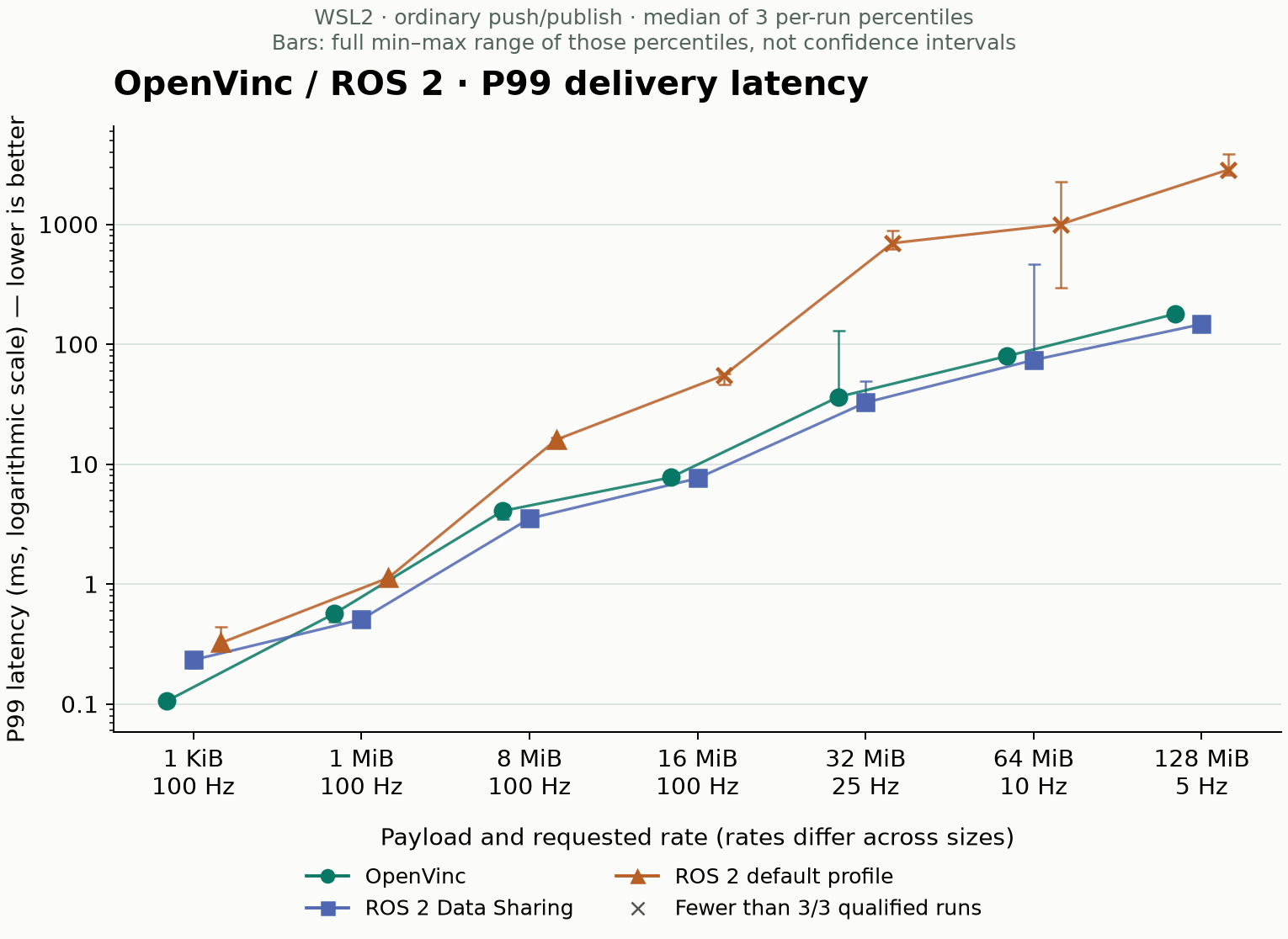
In this same-host, cross-process test, OpenVinc had lower P99 latency than the default ROS 2 profile at sizes where all three runs of both profiles qualified. Its latency was in a similar range to ROS 2 with Data Sharing tuning.
At 1 KiB, 1 MiB and 8 MiB—the sizes where all three default-profile runs qualified—OpenVinc’s P99 was 49.5–74.5% lower. Against tuned Data Sharing, OpenVinc’s P99 was 1.6–15.8% higher from 1 to 64 MiB and 21.6% higher at 128 MiB; OpenVinc was lower at 1 KiB. The tuned profile had a lower P99 at six of the seven sizes. All of these differences remain visible below.
This compares observed latency and complete delivery under the recorded workload. ROS 2 RELIABLE, BEST_EFFORT and OpenVinc’s overwrite-history contract provide different delivery guarantees. Qualified-run counts do not make those guarantees equivalent.
Latency results
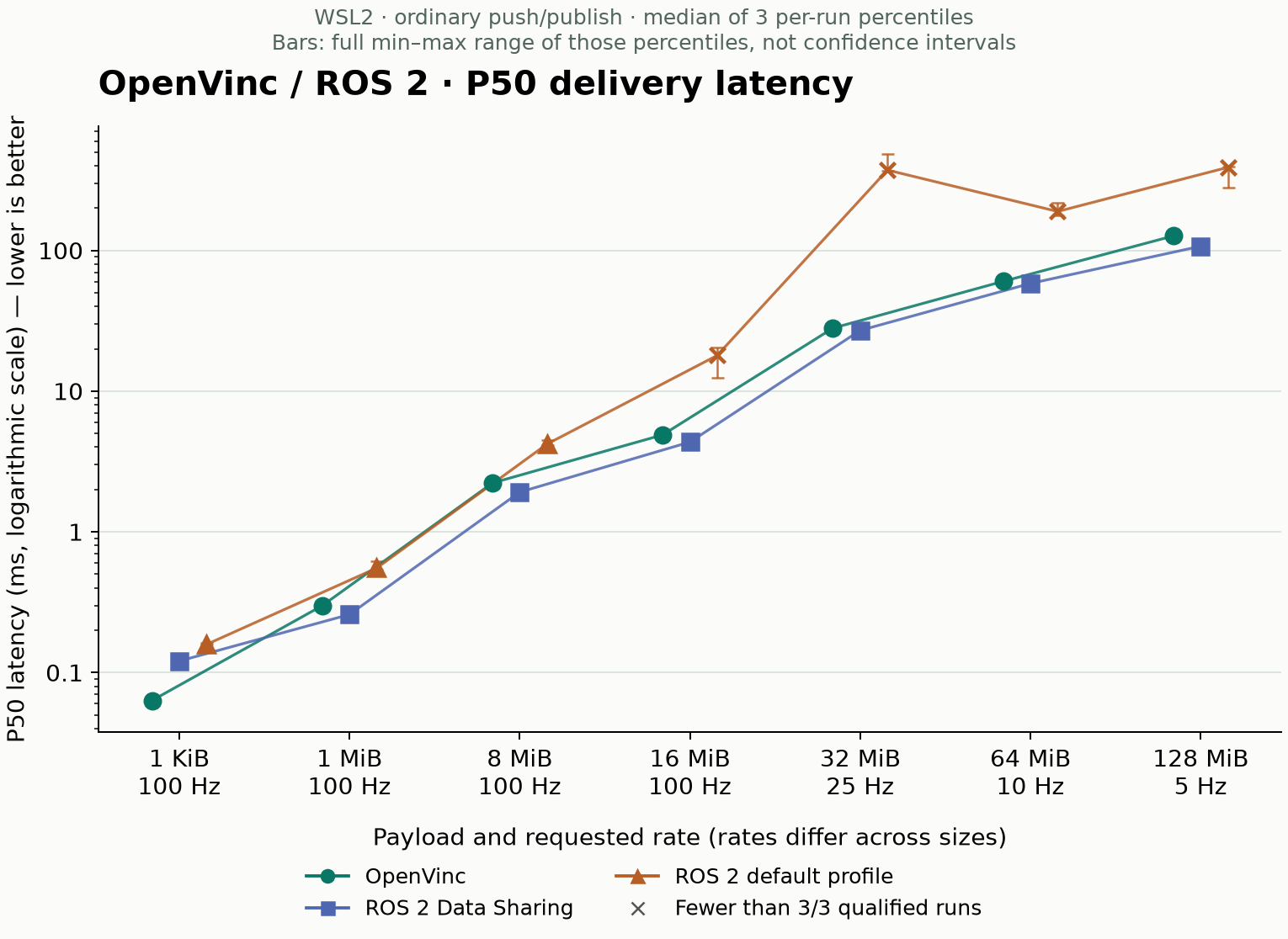
Section titled “Latency results”P50 is median latency; P99 describes the tail. Each number below is the median of three per-run percentiles, with the full three-run range retained. Each run contains 64 warmup and 1,000 formal messages; warmup is excluded from latency statistics.
The first four sizes run at 100 Hz. The 32, 64 and 128 MiB cases run at 25, 10 and 5 Hz respectively. All three profiles use the same requested rate within a payload size.
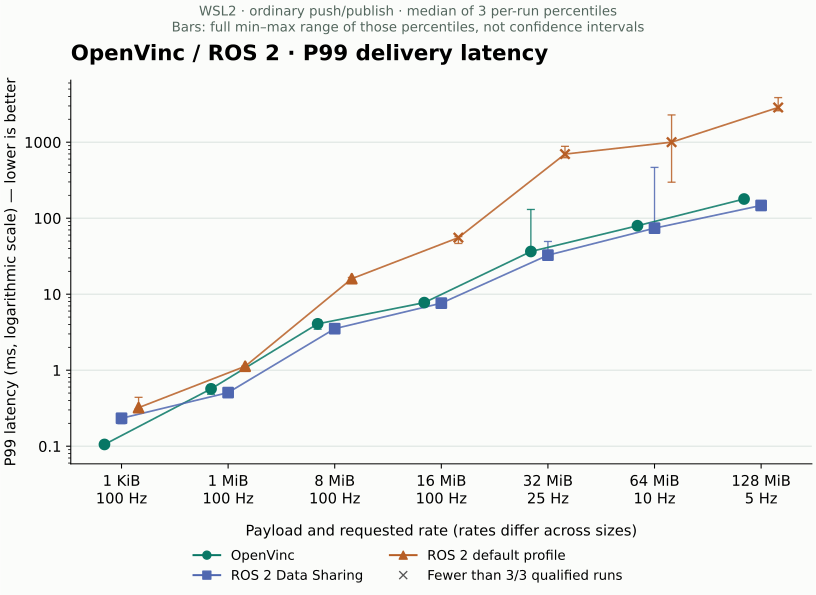
Download chart: SVG · PNG · PDF
| Payload / rate | OpenVinc | ROS 2 default | ROS 2 Data Sharing | Vs. tuned¹ |
|---|---|---|---|---|
| 1 KiB100 Hz | 0.1053/3 qualified | 0.3223/3 qualified | 0.2333/3 qualified | -54.8% |
| 1 MiB100 Hz | 0.5693/3 qualified | 1.1263/3 qualified | 0.5073/3 qualified | +12.1% |
| 8 MiB100 Hz | 4.0743/3 qualified | 15.9943/3 qualified | 3.5193/3 qualified | +15.8% |
| 16 MiB100 Hz | 7.7463/3 qualified | 55.4730/3 qualified | 7.6213/3 qualified | +1.6% |
| 32 MiB25 Hz | 36.4493/3 qualified | 697.0830/3 qualified | 32.6243/3 qualified | +11.7% |
| 64 MiB10 Hz | 79.5313/3 qualified | 1000.0962/3 qualified | 73.9083/3 qualified | +7.6% |
| 128 MiB5 Hz | 178.7213/3 qualified | 2860.5490/3 qualified | 147.0143/3 qualified | +21.6% |
Milliseconds. Each P99 is the median of three per-run values, not a percentile of pooled samples. Qualification checks delivery, rate and other conditions; it does not make the delivery guarantees equivalent. ¹ Difference = OpenVinc ÷ Data Sharing − 1; a positive value means higher OpenVinc latency.
Full three-run P99 ranges
| Payload | OpenVinc | ROS 2 default | ROS 2 Data Sharing |
|---|---|---|---|
| 1 KiB | 0.099–0.116 | 0.309–0.440 | 0.198–0.241 |
| 1 MiB | 0.484–0.636 | 1.105–1.130 | 0.495–0.543 |
| 8 MiB | 3.462–4.591 | 14.120–16.600 | 3.264–3.679 |
| 16 MiB | 7.098–7.961 | 46.504–57.238 | 6.935–8.023 |
| 32 MiB | 35.434–130.122 | 624.079–881.056 | 30.490–49.393 |
| 64 MiB | 76.883–81.317 | 297.296–2280.866 | 68.486–465.514 |
| 128 MiB | 175.338–188.565 | 2593.246–3854.930 | 139.923–153.464 |
Milliseconds; ranges are the smallest and largest per-run percentiles. Failed rounds remain in these statistics. Per-round maximum latency and qualification results are in the CSV and full archive.
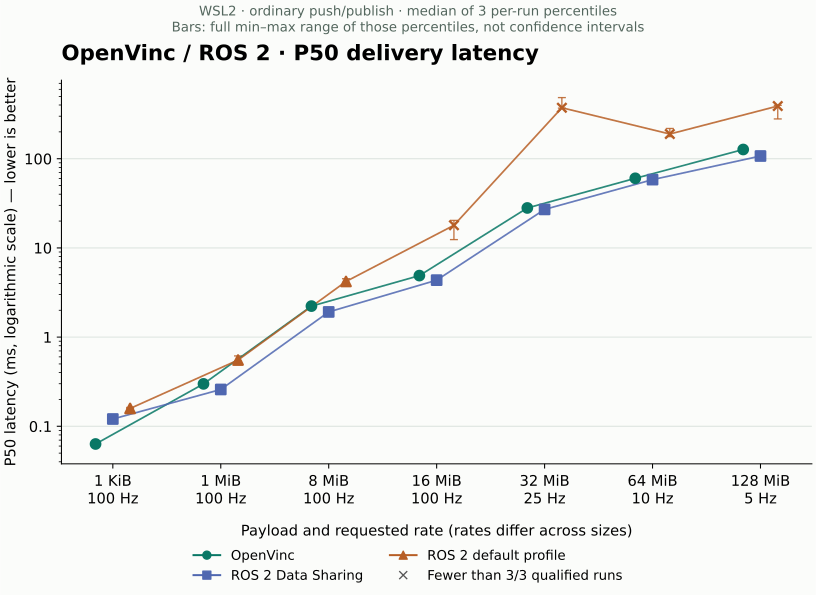
Download chart: SVG · PNG · PDF
| Payload / rate | OpenVinc | ROS 2 default | ROS 2 Data Sharing | Vs. tuned¹ |
|---|---|---|---|---|
| 1 KiB100 Hz | 0.0633/3 qualified | 0.1583/3 qualified | 0.1213/3 qualified | -47.6% |
| 1 MiB100 Hz | 0.2993/3 qualified | 0.5533/3 qualified | 0.2593/3 qualified | +15.5% |
| 8 MiB100 Hz | 2.2263/3 qualified | 4.2043/3 qualified | 1.9163/3 qualified | +16.2% |
| 16 MiB100 Hz | 4.8943/3 qualified | 17.9460/3 qualified | 4.3503/3 qualified | +12.5% |
| 32 MiB25 Hz | 28.0563/3 qualified | 372.7990/3 qualified | 27.0223/3 qualified | +3.8% |
| 64 MiB10 Hz | 60.3253/3 qualified | 189.2752/3 qualified | 58.3003/3 qualified | +3.5% |
| 128 MiB5 Hz | 126.9223/3 qualified | 389.7040/3 qualified | 107.2213/3 qualified | +18.4% |
Milliseconds. Each P50 is the median of three per-run values, not a percentile of pooled samples. Qualification checks delivery, rate and other conditions; it does not make the delivery guarantees equivalent. ¹ Difference = OpenVinc ÷ Data Sharing − 1; a positive value means higher OpenVinc latency.
Full three-run P50 ranges
| Payload | OpenVinc | ROS 2 default | ROS 2 Data Sharing |
|---|---|---|---|
| 1 KiB | 0.060–0.064 | 0.158–0.163 | 0.113–0.121 |
| 1 MiB | 0.285–0.299 | 0.536–0.615 | 0.258–0.269 |
| 8 MiB | 2.194–2.365 | 4.113–4.516 | 1.915–1.980 |
| 16 MiB | 4.846–4.898 | 12.399–20.357 | 4.292–4.508 |
| 32 MiB | 27.839–30.259 | 369.468–484.228 | 26.242–28.462 |
| 64 MiB | 59.529–60.483 | 177.105–218.296 | 55.920–59.263 |
| 128 MiB | 125.489–127.660 | 279.369–397.187 | 106.664–108.166 |
Milliseconds; ranges are the smallest and largest per-run percentiles. Failed rounds remain in these statistics. Per-round maximum latency and qualification results are in the CSV and full archive.
Variation beyond the median
Section titled “Variation beyond the median”At 32 MiB, OpenVinc’s three per-run P99 values span 35.434–130.122 ms, versus 30.490–49.393 ms for Data Sharing. At 64 MiB the pattern reverses: Data Sharing spans 68.486–465.514 ms, versus 76.883–81.317 ms for OpenVinc.
A single median cannot establish which system is more stable across every workload. The CSV and full report also retain the maximum individual latency from each run.
The three profiles
Section titled “The three profiles”| Profile | Settings used here |
|---|---|
| OpenVinc | Ordinary push with an independently owned local receive message. Sender loans are excluded from the main comparison. |
| ROS 2 default profile | Jazzy / rmw_fastrtps_cpp, RELIABLE, KeepLast, middleware-default transports without a forced transport, and the RMW’s default Data Sharing OFF. Unbounded byte-sequence messages. |
| ROS 2 Data Sharing tuning | BEST_EFFORT, explicit Data Sharing ON, per-size bounded messages, synchronous publication, adjusted history resources and SHM-only discovery/control transport. |
“Default” means the specific baseline above, rather than every ROS 2 backend or deployment. The tuned profile does not establish the best possible ROS 2 performance either.
Both ROS profiles disable RMW application loans and intra-process routing. A SharedPtr callback owns the independent local receive message. Data Sharing shares DDS history; copies between the application and DDS may remain. This page makes no end-to-end zero-copy claim. Fast DDS documentation
Depth is 32, reduced to 30 at 128 MiB. OpenVinc’s actual Bus allocation is capped at 4 GiB. Equal depth does not imply equal total memory consumption.
Method and environment
Section titled “Method and environment”The methodology was informed by Apex.AI’s performance_test project. This suite is independently implemented, without copying or linking that project’s code. The results here come from our own OpenVinc/ROS 2 workloads.
| Item | Recorded setup |
|---|---|
| Machine | AMD Ryzen 7 5700X3D, 16 logical CPUs |
| OS | WSL2 Ubuntu 24.04.5 on Windows 11 |
| Build | GCC 13.3, Release, native C++ APIs on both sides |
| ROS versions | ROS 2 Jazzy; rclcpp 28.1.22, rmw_fastrtps_cpp 8.4.4, Fast DDS 2.14.7, Fast CDR 2.2.8 |
| Processes | One Publisher and one Subscriber in separate processes; OpenVinc also has a central supervisor |
| Timing boundary | Publish API entry to receive-callback entry, after an independently owned local receive message is available; same-host CLOCK_MONOTONIC |
| Formal matrix | 7 sizes × 3 profiles × 3 runs = 63 runs, executed individually with alternating profile order |
| OpenVinc revision | a3a0843c5dc89f8b052c5f25afa66e1f171db99e, unmodified framework |
These measurements were taken on 2026-10-28–29, using a different framework revision from the current v0.2.0. They are not a new measurement of that release. The archive retains versions, build configuration, commands, binary SHA256 values and a workload source snapshot.
Publishers reuse a preinitialized local byte vector and update its sequence for each message. Latency excludes that local buffer’s initial allocation. Receive checks validate length, sequence and edge markers, rather than a full payload hash.
Calibration selects rates before the formal configuration is frozen. Failed 100 Hz pressure pilots for the larger sizes remain in the archive. Qualification includes all expected IDs, valid markers and actual rate within ±5% of the target, among other checks. OpenVinc additionally checks collisions and overwrite/loss counters. Unavailable ROS internal counters remain null, not measured zeros.
Scope of the result
Section titled “Scope of the result”- This is a one-to-one, same-host WSL2 test with interactive desktop background load. No busy spin, CPU affinity, priority or global timer adjustments were used.
- A 1,000-message run provides only about ten observations in its upper 1%. Three-run ranges expose variation but cannot establish long-duration or hard real-time guarantees.
- These same-host WSL2 measurements do not cover networked hosts, other DDS vendors, fan-out, multiple subscribers or dedicated real-time systems.
- Earlier
UniquePtrcallbacks introduced an extra deep copy. Those diagnostic runs remain underdiagnostics; the entire primary matrix was rerun usingSharedPtr. - The archive also includes one OpenVinc loan run per size. Its
commitlatency excludes preparation;full_pathincludes that preparation. These numbers are kept out of the ordinarypush/publishplots and tables above.
The full report also contains CPU and RSS measurements. CPU sampling windows differ between roles, and RSS repeats shared pages across processes, so these values are not simply added to compare total CPU or physical RAM.
Data and reproduction
Section titled “Data and reproduction”Dataset: 20261028-224514-735300. The complete ZIP contains the Chinese report, raw CSV, configurations and counters, calibration and failed attempts, provenance, source snapshot and license notices. It contains no executables or third-party runtimes.
- Complete data and source snapshot (ZIP, approximately 14.3 MiB)
- Per-run formal results and failure reasons (CSV, 63 runs)
- Data used by this page’s tables and plots (JSON)
- SHA256 of the complete ZIP
The archived verification record reports identical raw-CSV P50/P90/P99/max recomputation for all 116 attempts. This page’s import independently recomputed all 63 formal runs and checked their three-run aggregates. Failed rounds were neither repaired nor removed.
To reproduce, obtain the suite base commit recorded in provenance/git.json, apply the archived source/ working-tree snapshot, then follow source/ros2/README.md. Use that preserved snapshot rather than substituting the benchmark repository’s current branch contents.